
IFAC’s research suggests that Firms who accept PE investment believe there is a potential to set a higher standard—not only for their Firm but the entire accountancy profession— improving operational efficiency, service offerings, and competition for clients. Therefore, more Firms, regardless of size, may continue to seek PE investment— leading to a rationalization and reduction in the number of Firms.
The graphic below illustrates this consolidation. Over the last five years, direct PE investments in accountancy firms have led to a dramatically higher number of indirect or subsequent “roll-up” transactions. For example, in 2025, each direct PE investment resulted in 7.3 additional transactions. This “consolidation index” has increased dramatically since 2021. As of mid-year 2026, some 200 direct investments facilitated nearly 1200 subsequent / “roll-up” transactions.
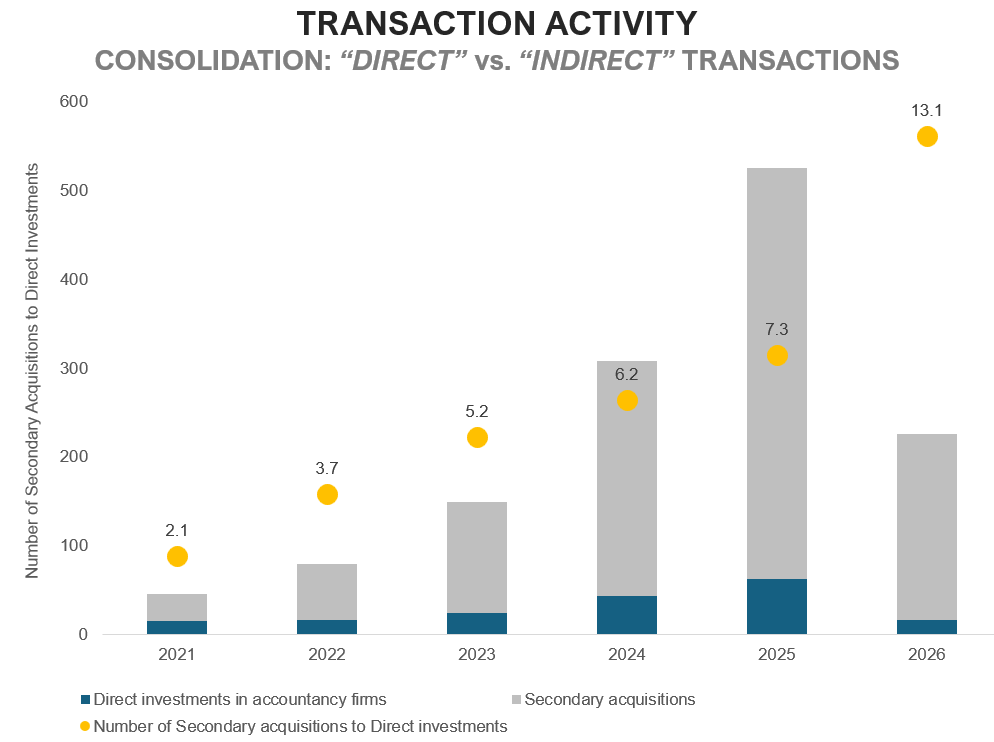
This data suggests that the structure of the market for accountancy services in jurisdictions where PE investment is prevalent (i.e., the UK/Ireland, U.S., and western Europe) is changing. Fewer, larger Firms in the future may introduce challenges, including higher fees for critical services like audit and tax advisory, but also potential opportunities from enhanced service offerings from larger and better resourced Firms and a more competitive environment for winning client engagements.
Note: Data for 2026 reflects only the first 6 months of the year, while all other years represent full 12-month periods.
-
Potential Challenges and Risks
PE-driven acquisitions, mergers and consolidation will result in fewer Firms. A reduced number of Firms—potentially charging higher fees for audit and advisory services—could impact all clients, but especially SMPs and their SME clients.
PE-backed Firms may re-assess their existing audit clients—dropping those that are larger, higher-profile, and higher risk in favor of more mid-tier clients (i.e., those subject to lighter regulatory oversight). Firms with insufficient market share in specific industries or in public interest entity (PIE) or stock exchange-traded audits may exit those markets. This dynamic could result in greater audit concentration, less client choice, and potentially higher fees for PIE and stock exchange-traded companies.
Commercial interests are likely to prioritize expanding advisory services, not audit and assurance. Therefore, PE investment may accelerate shifts away from audit / assurance services and de-emphasizing smaller, less-profitable engagements—again, resulting in higher fees for audit services.
IFAC’s research highlights that direct PE investment drives multiple “indirect” or “roll-up” acquisitions, which can reduce the number of Firms remaining in some professional associations and international networks. This consolidation may challenge the delivery of global service offerings from mid-tier Firm networks or associations.
Direct investments in accounting firms, as well as subsequent follow-on acquisitions, may introduce a more “corporate” and less client-centric environment and management style, which may not be a good match with existing clients or Firm employees—prompting defections (both clients and employees) from PE-backed Firms.
-
Potential Opportunities and Benefits
The accountancy profession is perhaps too fragmented in some jurisdictions—especially with respect to smaller firms—and could benefit from consolidation into better resourced, more resilient, more sustainable accounting Firms that can meet client needs. In addition to accelerating consolidation through roll-up transactions, PE investment can also incentivize mergers among independent Firms who do not wish to accept PE capital but will benefit from pooling resources.
Larger, more resilient Firms—who pursue growth through advisory services—will offer a broader range of higher-quality and more specialized services to clients.
A commercial focus on scale, revenue and growth may increase competition among PE-backed Firms for audit engagements, as well as drive expansion of non-audit/advisory services - which benefits clients.
PE investment is about scale and growth—so it seems very likely—and IFAC data demonstrates—there will be consolidation and fewer, larger accountancy firms in the future.