
Our Profession at a Crossroads: A video discussion on lessons from history for accounting's future
Alan Sangster, Professor of Accounting History at University of Aberdeen, recently sat down with Dr. Susan Smith, Professor of Accounting at University College London School of Management. Together, they explore how the accounting profession has transformed before, and how we can apply the lessons of history to today.
My recent article, A Profession at a Crossroads – Insights from a Historical Lens in the journal Accounting Horizons, compares what is happening now to the accounting profession through adoption of AI with what happened to bookkeepers in the 19th century, seeking to identify any lessons that may inform what happens next.
For 600 years the primary role of double entry accounting was the stewardship of assets and liabilities, focusing on cost and gross profit venture-by-venture, rather than overall net profit. Merchants opened an account for every good, batch, consignment, voyage and investment, charging to it the direct costs and any indirect costs that could be apportioned, so that each account served as both cost centre and profit centre. There were no accounts for sales or purchases and no true balance sheet.
While such an accounting system could produce accurate financial statements – the Jesuits’ Sicilian houses did so from 1636 – merchants trading at long distance rarely knew current figures for uncompleted ventures. For them, overall net profit had very little bearing on reality. It was not something they used their accounting systems to produce. Instead, their double entry accounting systems were designed to provide the information needed to manage their individual ventures.
Britain’s industrial revolution (c.1760–c.1830) expanded manufacturing and demand, but businesses remained sole traders, family firms or partnerships limited by law to six partners, without limited liability. Joint stock companies had been banned by the Bubble Act of 1720. The alternatives, a royal charter or a private act of Parliament, suited few. Venture accounting coped well enough with extraction firms and narrow product ranges, but became unworkable once a manufacturer had several products and indirect overheads to apportion – and no textbook taught factory accounting.
Accounting was at a crossroads, as were the bookkeepers.
The focus of accounting had to change to prioritise a different type of information: overall income and financial position, not individual ventures; and to retain their status, bookkeepers had to develop the skills needed to design and implement the new type of double entry accounting system.
The solution was a single trading account: direct costs debited, sales credited, closing inventory valued to reveal gross profit. Five statutes, listed in the graphic below, then transformed reporting. Railway networks, expanding rapidly from 1830 with large capital and ownership dispersed across the country, exacerbating the problem of a shortage of suitably skilled accountants.
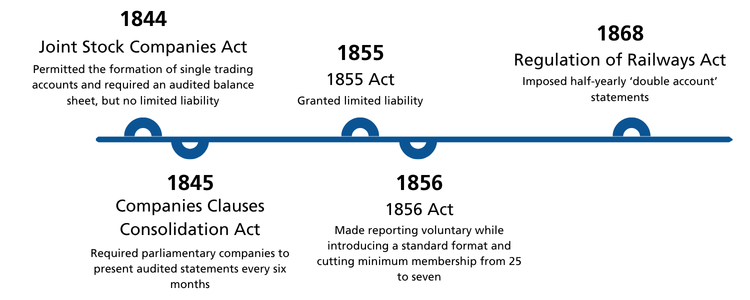
Over that period, joint stock companies became the norm, yet at first there were few professional accountants and no body controlling admission. The profession emerged as accountants trained in trust accounting and bankruptcy administration inside legal firms separated from those roots to compete with lawyers in the market for accountancy services. They brought experience of designing and using accounting systems to meet the needs of legislation, client skills suited to audit, and ready-made networks.
The first British accountancy body was founded in Edinburgh in 1853 and chartered by Queen Victoria in 1854; Glasgow followed in 1855, Aberdeen in 1867. English bodies began only in the 1870s, culminating in the ICAEW in 1880. The bookkeepers, isolated, without a guild or any standard practice, and no textbook on the new income-focused double entry accounting systems could not compete. While some did become accountants, the group as a whole lost status, replaced by professional accountants or became subordinate to them. They did not disappear, but directors no longer turned to them for financial accounting information.
Today, the accountancy profession finds itself at another crossroads.
For over a century, technology has entered into the tasks of accountants, strengthening their abilities rather than challenging their survival. Nevertheless, warnings have been issued for the past 50 years to accountants about the risk of being displaced by technology and by other professions. There is a risk of the accountancy profession being bypassed for other types of professionals if non-accountants embrace technology to perform faster or more successfully than the accountancy profession.
Artificial intelligence has finally reached the levels of capability envisaged in some of those warnings from the 1980s. Growing numbers of accounting tasks are being performed by AI. Recruitment to professional accounting is shifting towards those with technology expertise and good critical thinking skills. As a panelist at the recent annual conference of the British Accounting and Finance Association Accounting Education Special Interest Group noted, in some jurisdictions, students from the humanities are being preferred to accounting graduates. The tasks of entry-level professional accountants, in which they learnt how to do the accounting, are gradually disappearing.
The expertise accountants have in being able to determine which account to debit and which account to credit can be captured by AI. AI can detect errors and anomalies in large databases and conduct the tests on data that auditors would traditionally do. AI can produce financial statements from data without any human involvement.
Accountants using AI to perform or supplement what they are doing should be able to maintain the ability to do higher-level, higher-quality accountancy work than non-accountants using AI. Yet to do so, accountants are going to have to learn how to use AI. As with 19th century British bookkeepers, only those who make the effort to become expert in new technologies will be equipped to be the accountant of the future. If that does not happen, non-accountants who are expert in AI will be able to capture the expertise of accountants and do their job at a level that the accountants will not be able to match.
At its worst, accountants face the fate of the bookkeepers. Some recent studies reflect a slowness, complacency, and inconsistency within the profession in response to AI adoption and use. While one survey found 85% of professional accountants were willing to use AI, another found 88% recognised AI as a game changer but only 8% felt very well prepared, with 39% at best ‘slightly prepared’.
But the future is not all bleak, especially if we look back to the bookkeepers: they lacked relevant skills and had no professional organisation to guide them when it would have mattered. Their own institute was only formed in 1916, long after the transformation had passed them by.
Today’s accountants are members of professional accountancy bodies that can guide them, working together to create a profession-wide response, one in which the development of expertise in using AI is prioritised. They already have the vehicle for doing so: Continuing Professional Development.
Making the development of expertise in using AI a mandatory element of CPD for all members of those professional bodies is an obvious path to a solution, and there will be others as yet unidentified.
However, one thing is very clearly illuminated by history: at this crossroads, to avoid the fate of the bookkeepers, accountancy is only going to survive as a profession in the form and with the membership demographics it currently holds if it does what the bookkeepers did not. Organise itself into a united organisation where the professional bodies together lead their members down a path towards expertise in these new technologies.
