 An IFAC Content Series
Advocacy for a future of corporate reporting based on global standards, including IFRS S1 and IFRS S2 disclosures, is no longer just about awareness-raising and ISSB adoption decisions. Advocacy must now focus on high-quality implementation, otherwise the goal of globally consistent and comparable information for investors about sustainability-related risks and opportunities will not be achieved.
Background: Partnerships Enabling the Path to Global Standards
IFAC has consistently called for enhanced corporate reporting that captures all relevant information about organizations (see IFAC’s Point of View on Enhancing Corporate Reporting.) Investors and other stakeholders demand higher-quality information and insights about company performance, risks, opportunities, and long-term prospects than are available from the conventional financial reporting process.
The IFRS Foundation answered this call in 2021 with the establishment of the International Sustainability Standards Board (ISSB), which issued its first two standards—IFRS S1 and IFRS S2 in 2023. IFAC and other stakeholders who support global standards and a harmonized approach to sustainability-related information have advocated for the adoption of both Standards, which is happening at pace, with some 40 jurisdictions deciding to use or take steps to introduce ISSB Standards into the jurisdictions.
Now, recognizing the need for a pivot towards high-quality implementation, IFAC recently completed a unique pilot event intended to deliver a deep dive into IFRS S1 and IFRS S2, including:
- Conceptual foundations of ISSB Standards
- Core content (governance, strategy, risk management, metrics & targets)
- Materiality, connection to the financial statements, and industry-specific disclosures
- Proportionality mechanisms and transition reliefs
- Climate scenario analysis and Scope 3 emissions
- Assurance of sustainability information
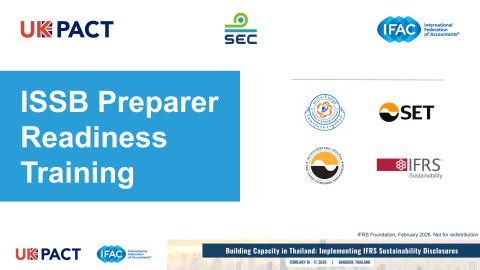
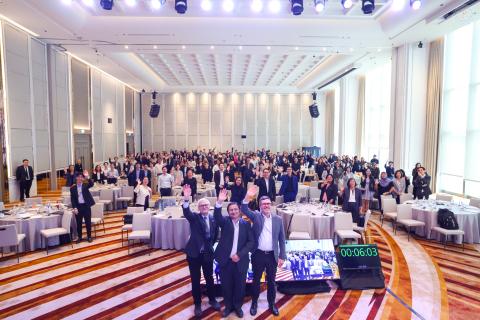
Working in partnership with an international development organization, UK PACT in Thailand, and in collaboration with the ISSB and local regulators and stakeholders, the two-day training and capacity building program took place in Bangkok on February 16-17th, 2026. The nearly 200 attendees included Thai companies who will begin ISSB reporting in fiscal years 2027 and 2028.
IFAC’s Chief Executive Officer, Lee White, expressed his appreciation for the occasion, saying, “On behalf of IFAC and the global profession, I thank UK PACT for their purpose-driven financial support of this important pilot training event, as well as the Securities and Exchange Commission, Thailand; the Stock Exchange of Thailand; the Thai Listed Company Association; and the Federation of Accounting Professions (TFAC) for their strong support of the ISSB’s mission. Your efforts made this event a success. It was an honour to have such distinguished organizations present with us in Bangkok.”
Welcome Remarks

Mr. David Thomas, Deputy Head of Mission, British Embassy, Bangkok

Ms. Pornanong Budsaratragoon, Secretary General, The Securities and Exchange Commission, Thailand

Mr. Winid Silamongkol, President, Federation of Accounting Professions, Thailand
Part 1: A Multi-stakeholder Discussion
To help demonstrate the importance of ISSB adoption in Thailand, the event featured a high-level panel discussion led by Michiel van der Lof, EY’s Global Corporate Reporting Services Leader. The panel brought together perspectives from investors, preparers, and standard-setters, highlighting both the strategic benefits and practical challenges of implementation.
Participants included:
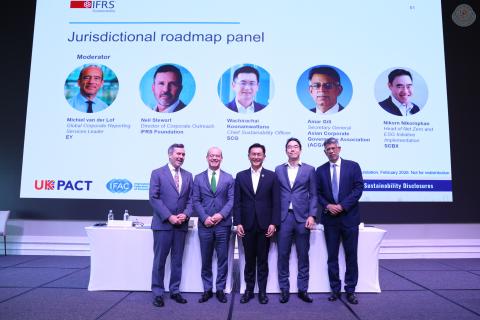
- Amar Gill, Secretary General Asian Corporate Governance Association;
- Wachirachai Koonamwattana, Chief Sustainability Officer of SCG;
- Nikorn Nikornphan, Head of Net Zero and ESG Initiative Implementation at SCBX; and
- Neil Stewart, Director of Corporate Outreach, ISSB
This multi-stakeholder dialogue set the foundation for the training that followed by connecting global standards with local realities. Participants discussed how:
- The work of sustainability specialists and finance specialists within companies is converging, and their combined expertise is critical to high-quality ISSB disclosures.
- ISSB reporting should not be a new compliance exercise. Rather, integrating sustainability-related measurement and disclosure into a company’s strategy and decision-making will demonstrate the true benefits of ISSB requirements.
- Data quality, for example with respect to Scope 3 emissions, is a common challenge for reporting entities.
- Financial materiality is key. GRI and sustainability information that Thai companies may already be reporting can help, but it may not be the material, investor-useful information that S1 and S2 are designed to deliver to investors.
- Finally, investors are looking for comparability—especially long-term focused pension plans and other types of asset owners. Passive investment strategies like ETFs will also greatly benefit from high-quality ISSB information.
Part 2: The Four-Module Approach
Building on prior training programs delivered in Singapore and Malaysia, IFAC and the ISSB refined a structured curriculum tailored for preparers. Malik Mirza, Managing Director and CEO of Finman Group and Neil Stewart from the ISSB were co-presenters over the two-day session, assisted by many supporters from TFAC, SEC, SET, EY, PwC, KPMG, and others.
The program followed a four-module approach, closely aligned with the ISSB framework and reinforced through practical application. Over the two days, the training covered:
- Module 1: Purpose and key features of ISSB Standards
- Module 2: Scope and conceptual foundations, including identification of sustainability-related risks, opportunities, and material information
- Module 3: Core content—governance, strategy, risk management, metrics, and targets (aligned with TCFD principles)
- Module 4: General requirements, including judgement, uncertainties, comparability, location of disclosures, and assurability.
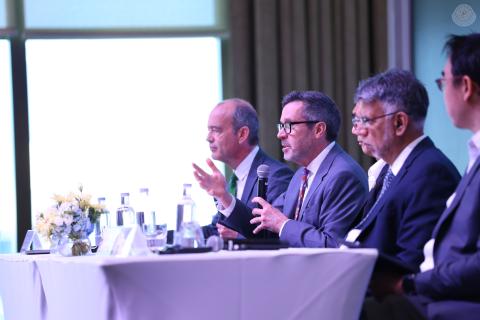
Neil Stewart noted: “The curriculum addresses the learning needs of Thai corporate reporters who will soon be required to apply IFRS S1 and IFRS S2, as well as auditors and advisors who are working with them. It provides both conceptual understanding and practical insights on how to disclose sustainability-related risks and opportunities in the value chain, matters of judgements and uncertainties, and the importance of assurability. Our work with IFAC and others supports consistent application of ISSB Standards – and ultimately better information for investors.”
The program design was also highly interactive, incorporating:
- Table-top discussions on identifying risks, opportunities, and material disclosures;
- Scenario analysis exercises linked to climate risk;
- Deep dives into Scope 3 emissions and supply chain engagement; and
- Continuous Q&A and feedback loops.
Malik Mirza, Managing Director and CEO of Finman Group and co-presenter of the program, emphasized: “Effective implementation of IFRS S1 and S2 requires more than technical understanding—it demands active engagement, contextualization, and practical application. We deliberately integrated local company case studies, interactive table-top discussions, and real-world scenarios. This approach reflects Finman Group’s work across emerging markets, where capacity building on IFRS Sustainability Disclosure Standards is increasingly focused on bridging the gap between global frameworks and local implementation realities.”
Part 3: Strengthening Audience Understanding Through Case Studies
Two highlights of the training were real-world Thai company case studies. These sessions enabled participants to deepen their understanding of specific disclosure requirements through the lens of local company experiences.
Chompan Kulnies, the Chief Sustainability Officer of Minor International, demonstrated how scenario analysis can be used to assess climate-related risks and opportunities.
Patima Sinthupinoyo, SCG’s Lead of ESG Governance and Integration, presented practical challenges and approaches to collecting high-quality supply chain data, particularly Scope 3 emissions.
Conclusion: Accountancy Profession Must Play a Key Role
The second day of the training extended beyond disclosures into assurance and the role it plays in delivering trust and confidence in sustainability information. IFAC presented insights from its State of Play research and the Chairs of both the IAASB and IESBA shared their perspectives on enabling the path to global standards. This reinforced the critical role of the accountancy profession in ensuring the reliability and decision-usefulness of sustainability information.
A Call to Action: The accountancy profession sits at the heart of data, information, and decision-making, so we have the unique opportunity to work with professionals who have expertise in sustainability matters and others—taking a true cross-functional approach that will shape the future of corporate reporting and empower transformational change within organizations. However, the adoption of ISSB Standards is only the beginning. The real challenge lies in translating these high-quality standards into high-quality information that informs decision-making, strategy and risk assessments, capital allocation, and new operating models—all taking sustainability-related risks and opportunities into account.
IFAC is honored to have contributed to this important milestone in Thailand, marking a significant step toward global, high-quality sustainability reporting implementation.
