  • Global Search for Volunteer Members to Join the IPSASB

    English

    The IFAC Nominating Committee has launched a global search for volunteer members to serve on the International Public Sector Accounting Standards Board® (IPSASB®), an independent standard-setting body that develops and maintains accrual-based International Public Sector Accounting Standards® (IPSAS®), IPSASB Sustainability Reporting Standards™ (IPSASB SRS™), and other high-quality reporting guidance for use by governments and public sector entities worldwide.

    The Nominating Committee is seeking nominations from a wide range of relevant backgrounds, including:

    • Public sector standard setters and external auditors;
    • Preparers of accrual-based financial statements and/or public sector sustainability reports such as from Ministries of Finance, Accountants Generals’ Departments, or other institutions;
    • Users of general-purpose financial reports, such as parliamentarians, budget officials, and credit-rating agencies; and
    • Professionals from jurisdictions that are transitioning to or have already implemented IPSAS.

    Candidates should have relevant experience, such as strong knowledge of financial or sustainability reporting issues, accounting standard-setting experience, direct involvement in public financial management reforms, and/or familiarity with the needs of financial statement users. Excellent written and spoken English is required.

    Selected members will serve an initial three-year term beginning January 1, 2027, with the possibility of renewal for an additional term.

    All stakeholders, including from national, state, and local governments, national standard setters, IFAC member organizations, the Forum of Firms and their members from public accounting firms, other organizations, and members of the general public, are encouraged to nominate candidates or apply.

    Nominations from all regions of the world are encouraged.

    “The IPSASB plays a vital role in strengthening trust, accountability, and sustainability in public financial management worldwide,” said Jon Blondal, Co-Chair of the Public Interest Committee. “Serving on the Board is an opportunity to help shape the standards that improve how governments manage public resources and report to their citizens.”

    “Supporting high-quality international standards is a core part of how we deliver value to our members and the global profession,” said Lee White, IFAC Chief Executive Officer. “The IPSASB’s work supports transparency, accountability, and trust in the public sector. We encourage professionals who share that commitment to consider serving and contributing their experience to this important work.”

    The deadline for submitting applications is January 31, 2026.

    Please see the Call for Nominations for more details and information on how to submit an application.

    About IFAC

    IFAC, by connecting and uniting its members, makes the accountancy profession truly global.

    IFAC member organizations are champions of integrity and professional quality, and proudly carry their membership as a badge of international recognition.

    IFAC and its members work together to shape the future of the profession through learning, innovation, a collective voice, and commitment to the public interest.

    About the IPSASB
    The International Public Sector Accounting Standards Board (IPSASB) works to strengthen public financial management globally through developing and maintaining accrual-based International Public Sector Accounting Standards (IPSAS Standards), IPSASB Sustainability Reporting Standards (IPSASB SRS™ Standards) and other high-quality financial reporting guidance for use by governments and other public sector entities. It also raises awareness of IPSAS Standards and IPSASB SRS Standards and promotes the adoption and implementation of these to enhance the quality and consistency of practice throughout the world and strengthen the transparency and accountability of public sector finances and sustainable development. The Board receives support from the Asian Development Bank, the Chartered Professional Accountants of Canada, the New Zealand External Reporting Board, the government of Canada, and The World Bank. The structures and processes that support the operations of the IPSASB are facilitated by the International Federation of Accountants (IFAC®). For copyright, trademark, and permissions information, please go to permissions or contact permissions@ifac.org.

    About the Public Interest Committee
    The governance and standard-setting activities of the IPSASB are overseen by the Public Interest Committee (PIC), to ensure that they follow due process and reflect the public interest. The PIC is comprised of individuals with expertise in public sector or financial reporting, and professional engagement in organizations that have an interest in promoting high-quality and internationally comparable financial information.

    About the Nominating Committee

    The Nominating Committee makes recommendations to the International Federation of Accountants (IFAC) Board on the composition of the IPSASB and other IFAC Groups. The Nominating Committee is guided in its work by the principle of selecting the most suitable candidate for the position. The Committee also seeks diversity in gender, regional, and professional background, as well as representation from jurisdictions with different levels of economic development.

    The Public Interest Committee oversees the nomination process for IPSASB membership and provides its advice. To learn more about the Nominating Committee, please visit the IFAC website

    Submit by January 31, 2026

  • IPSASB Conforms its Definition of Material

    New York, New York English

    The International Public Sector Accounting Standards Board (IPSASB®), developer of IPSAS® Standards, international accrual-based accounting standards for use by governments and other public sector entities around the world, has issued Definition of Material (Amendments to IPSAS 1, IPSAS 3, and the Conceptual Framework).

    “The amendments aim to bring consistency into our guidance on the definition of material, helping organizations apply it more effectively,” said Ian Carruthers, IPSASB Chair. "A clear and well-understood definition will serve as a solid foundation for our planned guidance on how to make materiality judgments to be developed during the second phase of this project.”

    The amendments:

    • Clarify that an entity is required to consider the information needs of primary users instead of other users of GPFRs; and
    • Align the definition of material in IPSAS 1, Presentation of Financial Statements, with Chapter 3 of the Conceptual Framework on Qualitative Characteristics.

    The amendments will help strengthen accountability by ensuring financial statements focus on information most relevant to primary users. They will enhance consistency through conforming the definition of the term material between the Conceptual Framework and within IPSASB’s authoritative guidance and lay the foundation for planned guidance on materiality judgments in financial and reporting.

    The second phase of the project includes developing non-authoritative guidance aligned with IFRS® Practice Statement 2, Making Materiality Judgements, to efficiently and promptly address constituents' need for additional guidance on making materiality judgments when preparing financial statements in accordance with IPSAS Standards.

    The amendments to IPSAS Standards in the Definition of Material (Amendments to IPSAS 1, IPSAS 3, and the Conceptual Framework) are effective January 1, 2027. An earlier application is permitted. The amendments to the Conceptual Framework are effective immediately.

    About the IPSASB
    The International Public Sector Accounting Standards Board (IPSASB) works to strengthen public financial management globally through developing and maintaining accrual-based International Public Sector Accounting Standards (IPSAS Standards), IPSASB Sustainability Reporting Standards (IPSASB SRS™ Standards) and other high-quality financial reporting guidance for use by governments and other public sector entities. It also raises awareness of IPSAS Standards and IPSASB SRS Standards and promotes the adoption and implementation of these to enhance the quality and consistency of practice throughout the world and strengthen the transparency and accountability of public sector finances and sustainable development. The Board receives support from the Asian Development Bank, the Chartered Professional Accountants of Canada, the New Zealand External Reporting Board, the government of Canada, and The World Bank. The structures and processes that support the operations of the IPSASB are facilitated by the International Federation of Accountants (IFAC®). For copyright, trademark, and permissions information, please go to permissions or contact permissions@ifac.org.


    About the Public Interest Committee
    The governance and standard-setting activities of the IPSASB are overseen by the Public Interest Committee (PIC), to ensure that they follow due process and reflect the public interest. The PIC is comprised of individuals with expertise in public sector or financial reporting, and professional engagement in organizations that have an interest in promoting high-quality and internationally comparable financial information.

  • IPSAS Handbuch 2024

    Expected publication Date: 2025-09-30

    IPSASB
    German
    In Progress
  • IPSASB Consults on its Future Work Program Projects

    New York, New York English

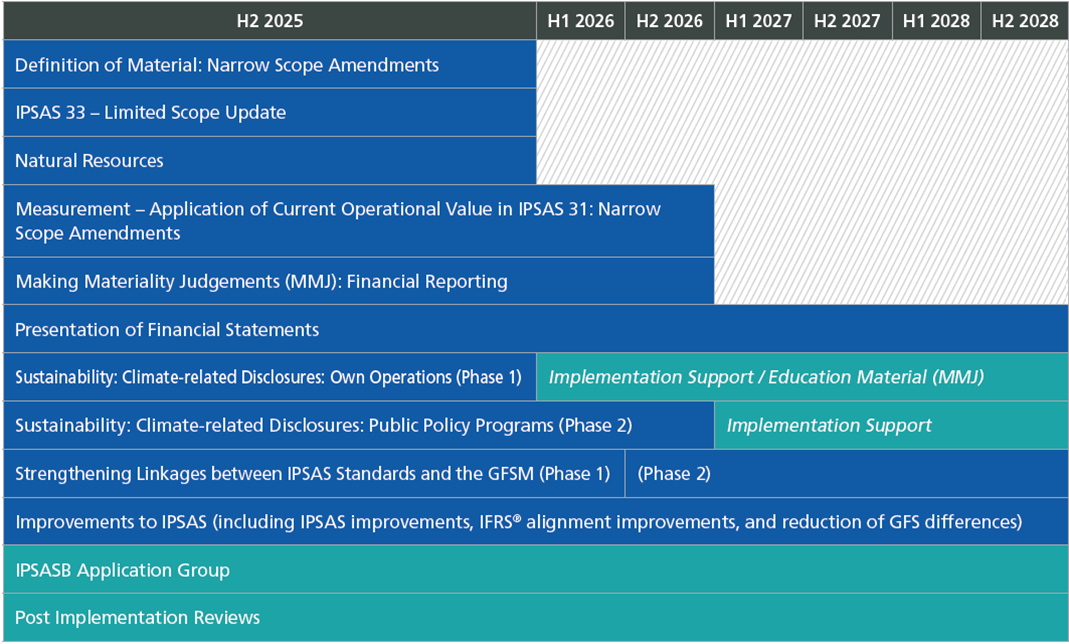
    The International Public Sector Accounting Standards Board® (IPSASB®) has published its Work Program Consultation. Having set its overall strategy for the period 2024-2028 through a public consultation, this new Consultation seeks to understand stakeholders’ greatest needs in relation to individual financial reporting projects, post implementation reviews and sustainability reporting projects. By engaging with its stakeholders, the IPSASB aims to ensure its future work program projects are responsive, relevant, and aligned with the evolving needs of the global public sector.

    IPSASB-2025-WPC
    IPSASB Current Work Program 2025-2028. Items in blue represent current ongoing IPSASB financial reporting and sustainability reporting projects. Items in green represent ongoing items primarily related to implementation and education support activities which utilize IPSASB resources - including maintenance activities. The bars represent the expected timing of completion for all ongoing projects, and the expected commencement and completion for new projects.

    “Understanding the greatest needs of stakeholders will allow the Board to determine how best to deploy resources as they become available,” said Ian Carruthers, IPSASB Chair. “With resources to undertake new initiatives anticipated to become available during 2026 and onwards, the IPSASB decided that now is the time to consult with stakeholders to determine their future project needs.”

    IPSASB will take decisions during 2026 on the individual projects to add to its future work program based on stakeholder feedback from the consultation that last until May 4, 2026, bearing in mind the available Board resources.


    How to Access
    Access the IPSASB’s Work Program Consultation. The IPSASB encourages IFAC members, associates, and Network Partners to promote the availability of the Work Program Consultation and encourages all interested stakeholders to respond to inform the IPSASB as it sets it next Work Program.

    About the IPSASB
    The International Public Sector Accounting Standards Board (IPSASB) works to strengthen public financial management globally through developing and maintaining accrual-based International Public Sector Accounting Standards (IPSAS Standards), IPSASB Sustainability Reporting Standards (IPSASB SRS™ Standards) and other high-quality financial reporting guidance for use by governments and other public sector entities. It also raises awareness of IPSAS Standards and IPSASB SRS Standards and promotes the adoption and implementation of these to enhance the quality and consistency of practice throughout the world and strengthen the transparency and accountability of public sector finances and sustainable development. The Board receives support from the Asian Development Bank, the Chartered Professional Accountants of Canada, the New Zealand External Reporting Board, the government of Canada, and The World Bank. The structures and processes that support the operations of the IPSASB are facilitated by the International Federation of Accountants (IFAC®). For copyright, trademark, and permissions information, please go to permissions or contact permissions@ifac.org.

    About the Public Interest Committee
    The governance and standard-setting activities of the IPSASB are overseen by the Public Interest Committee (PIC), to ensure that they follow due process and reflect the public interest. The PIC is comprised of individuals with expertise in public sector or financial reporting, and professional engagement in organizations that have an interest in promoting high-quality and internationally comparable financial information.

  • IPSASB 2025 Work Program Consultation

    The IPSASB wants to hear from stakeholders what projects are most important to them in delivering the IPSASB's Strategy and Work Plan 2024-2028Having set its overall strategy for the period 2024-2028 through a public consultation, this consultation seeks to understand stakeholders’ greatest needs in relation to individual financial reporting projects, post implementation reviews, and sustainability reporting projects.

    Published:
    |
  • Definition of Material (Amendments to IPSAS 1, IPSAS 3, and the Conceptual Framework)

    This pronouncement conforms the definition of the term material between the Conceptual Framework and within IPSASB’s authoritative guidance and lays the foundation for planned guidance on materiality judgments in financial reporting. It clarifies that general-purpose financial reports are prepared to meet the information needs of primary users for accountability and decision-making purposes.

    IPSASB
    English